Students in my science classes can use this blog to easily access class information, labs, activities, and projects. It is a great way to be in communication!
Pages
- Home
- Extra Credit
- Pictures from class
- Helpful Websites
- Projects and Labs
- "The Demise of the Halloween Pumpkins"
- Above and Beyond Science
- Students of the Months
- Notes, Graphic Organizers, and Cool Resources
- Science Songs and Raps!!
- Testimonials and Advice
- Course Syllabus and Expectations
- Portfolios in Science
- Conservation Awareness and Fundraising
- "How To" videos and Tutorials
Sunday, November 10, 2013
Monday, November 4, 2013
Friday, November 1, 2013
11/4-11/8
Monday
| -Review cells and organelles, correct homework -Quiz on labeling the parts of plant and animal cells/matching organelles with functions Thursday, 11/7 -Set up matching game that should be used as a study guide -Internet lesson: Cells in Perspective and Alive! Using Chrome books (websites: http://www.cellsalive.com/cells/cell_model.htm and http://learn.genetics.utah.edu/content/begin/cells/ |
Tuesday
| - Continue Internet lesson -Review for Quiz |
Wednesday
| -Cell Charades! |
Thursday
| -Quiz - Cell organelles labeling and matching organelles with functions |
Friday
| - Cell-a-bration!!!! -Cell Projects are due today! |
Wednesday, October 30, 2013
Cell-a-bration!!!
October 31, 2013
Dear Parents and Guardians,
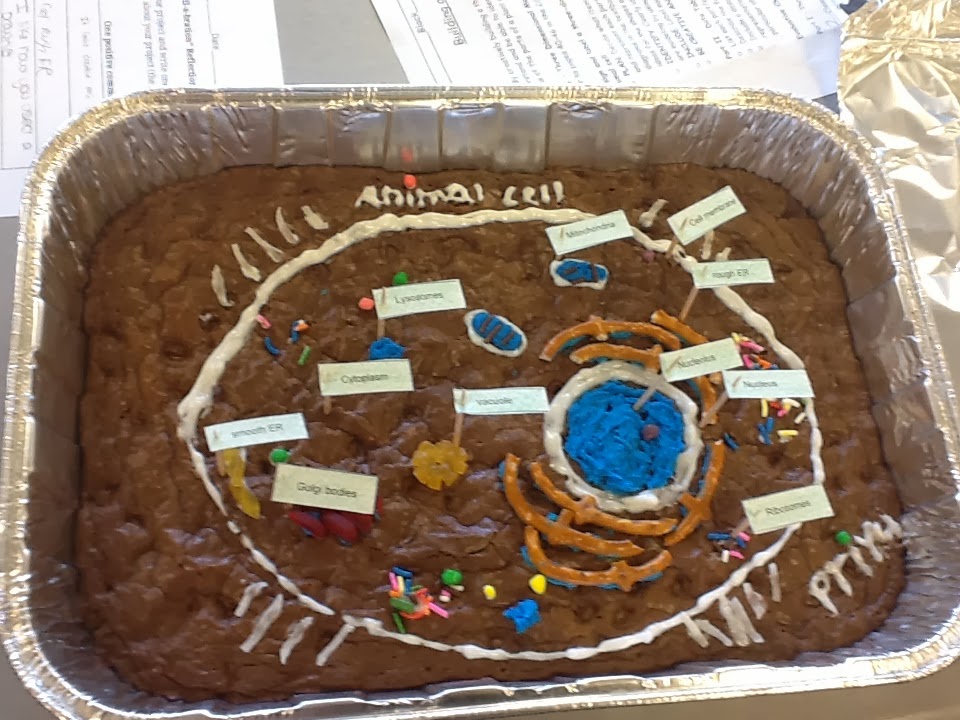
Students have begun a unit on The Cell, chapter 2 (pgs. 40-47) in the Life’s Structure and Function textbook. We have studied all about the various organelles and parts and how each has a particular function. Students have been assigned a project called, Building a Cell. Students will create a three-dimensional model of a plant or animal cell. Please see the project directions sheet for details.
Many creative ideas are available to students and some are discussed in class. Students are encouraged to use recyclable materials and other inexpensive objects that represent by shape, size and color the various organelles that are found in the cell. Shoe boxes work great as well as plastic containers. In the past some cells were made out of cake decorated with various types of candies each chosen carefully to represent the parts of a cell and some were made out of pizza. Other cells have been made out of foam or Styrofoam.
This Cell project is due Friday, November 8th. On this day students will present and share their projects. The classroom will be a virtual cell museum. I call this very special day, “Cell-a-Bration”. We celebrate remarkable and amazing cells. Students are allowed to eat the edible cells if they wish. This is a really fun visual and kinesthetic activity that engages student learning of the cell as well as helping to reinforce concepts.
Sincerely,
Mrs. Pratt
Saturday, October 26, 2013
10/28-11/1
Monday
| -Begin "The Cell" Chapter 2 -Two types of cells: Prokaryotes and Eukaryotes -Cell organelles and functions |
Tuesday
| -"The Demise of the Halloween Pumpkins" assignment due -Continue to read about cell organelles and their functions -Cell analogies |
Wednesday
| -Cells and organelles |
Thursday
| -Continue to discuss cells and organelles Happy Halloween!! |
Friday
| -Introduce Cell Project -Discuss Cell Project expectations and ideas |
Sunday, October 20, 2013
10/21-10/25
Monday
| -Blog Assignment Due -Pumpkin observations -Read about Classification; Notes -Quiz on Wednesday, 10/23 |
Tuesday
| -Plant Lab Due -Continue Notes -Pumpkin observations |
Wednesday
| -Pumpkin observations -Review for Quiz |
Thursday
| -Quiz on Classification (pgs. 24-28) -Pumpkin Observations |
Friday
| -Finish Leaf Taxonomy Key activity -"The Demise of the Halloween Pumpkins" activity Due 10/29 |
Saturday, October 12, 2013
How Did Plants Evolve?
Please watch this podcast. The information can help further your understanding of the lab.
Write a 2-3 paragraph response to the following task:
Your task: You need to find a way to survive with your feet permanently anchored in cement?
You Can't:
- Hide from predators
- Seek a mate
- Walk to water or food
- Change your habitat
You Have to:
- Get necessary nutrients
- Get water and oxygen
- Reproduce (your mate may be mile away)
- Deal with changes in your environment (i.e. dry, wet, hot, cold, dark, light etc..)
10/14-10/18
Monday
| -No School - Columbus Day |
Tuesday
| -Lab: The Evolution of Plants: Form Fits Function -Pumpkin observations |
Wednesday
| -Finish Lab -Portfolio Reflections are due!!! -Pumpkin observations |
Thursday
| -Classification; Domains and Kingdoms -Pumpkin observations |
Friday
| -Prokaryotes and Eukaryotes -Pumpkin observations |
Sunday, October 6, 2013
Spontaneous Generation Animation
This is an animation and tutorial that explains the different experiments done by scientists that eventually disproved the Theory of Spontaneous Generation.
Click on this link: Spontaneous Generation Animation
Saturday, October 5, 2013
10/7-10/11
Monday
| -Observe pumpkins and record data -Set-up Spallanzani boiled broth demonstration -Check textbook covers -Notes on Where Does Life Come From? -Begin Origins: How Life Began video; notes |
Tuesday
| -Review for Quiz -Continue video -Record pumpkin data |
Wednesday
| -Quiz on Where Does Life Come From? Sect.1.3 (pgs. 21-23) -Continue Video -Record pumpkin data |
Thursday
| -Finish Video -Begin lab, Evidence of Plant Evolution: Form Fits Function -Record pumpkin data |
Friday
| -Work on Lab -Record pumpkin data |
Wednesday, October 2, 2013
Sunday, September 29, 2013
This Week in Science
Interesting Podcasts about all different genre in the world of science. Check it out!!
Click on this link: http://www.twis.org/
Meal worm Behavior Virtual lab
Learn more about Responding and Adjusting (one of the 8 Features of Life) by doing this virtual lab about meal worms.
Click on the link: Virtual Lab
9/30-10/4
Monday
| -Work on Mealworm Lab -Learn about Variables |
Tuesday
| -Finish Mealworm Lab |
Wednesday
| -Where Does Life Come From? (pgs. 21-23) -Hand out textbooks -"The Demise of the Halloween Pumpkins" -Observe and predict |
Thursday
| -Discuss Theories and scientists, timeline -Pumpkins observations |
Friday
| -Pumpkins observations -Mealworm Lab due -Coacervate demo -Quiz on Wednesday 10/9 |
Tuesday, September 24, 2013
Homeostasis of the Eye Lab
This is a great YouTube video, 14 min or so, that helps explain positive and negative feedback loops. Some of the information is a bit advanced but it can provide some basic information to help understand the lab and to advance your learning :)
Click on this link: Positive and Negative Feedback Loops and Homeostasis
Friday, September 20, 2013
Friday, September 13, 2013
8 Features of Living Things Mini-Project
Students have been assigned this short and creative project to help reinforce their learning of the 8 features of living things. Students may choose either the cartoon or comic strip design and then they should research their chosen organism and plan their project to show how each of the 8 features applies to or "fits" their chosen organism. Ultimately, proving that their organism is indeed a living thing. Students will be given some time in school to work on this project and use iPads to research. Some time may be required to work on this project at home.
Citation Machine
Comments:
DUE: Tuesday, 9/24
Name______________________________________Date_______________
Features of Living Things Mini-Project
Goal: To Create a Comic-Strip or Cartoon that portrays, describes and illustrates the 8 Features of Living Things of a specific organism.
- Choose a specific organism. Examples: zebra, alligator, hummingbird, mushroom, etc...
- Think of examples and describe how each of the 8 features “fits” or applies to your chosen organism. This part should be completed as a brainstorming rough draft. You may need to research a bit to find out specific information.
- Create a cartoon (one plate design) or a comic strip (many plate design) to show how each of the 8 features applies to your chosen organism.
- Illustrate your organism using color and design to show each feature.
- You may do this using a cartoon design where you would draw the organism and then provide labels in places where each of the 8 features would be represented.
- You may do this using a comic strip design where you would create separate plates that show your organism representing the 8 features.
- Label each feature neatly in a talking bubble and provide a description of how that feature applies to your organism.
- Include your name and date on the bottom, right-hand corner of the paper.
- Include a border that extends all the way around all sides of the paper.
- Have FUN!!
Checklist
___5___ Organism chosen is a living thing and evidence for this is substantial.
___3___ Name and date are on the bottom, right-hand corner of paper.
___2___ Border extends all the way around all sides of the paper.
___10__ Neatness, care, effort and color in your design and descriptions.
___35__ 8 features are represented and are correct.
___35__ 8 features are described inside a talking bubble and are accurate.
___10___ Works Cited: Use Citation MachineCitation Machine
___100_
Comments:
9/16-9/20
Monday
| -Crazy Catapult Challenge: design, fastest to knock down a fortress, accuracy shooting a target |
Tuesday
| -8 Characteristics of Life, review key ideas and notes -Go over Dog vs. Stream |
Wednesday
| -Introduce and work on 8 Features of Living Things Mini-Project |
Thursday
| -Work on mini-project (Due: Tuesday 9/24) |
Friday
| -Work on mini-project (Due: Tuesday 9/24) |
Sunday, September 8, 2013
9/9-9/13
Monday
| -Science Current Event Write-ups Due; Share in class -Introduce: Crazy Catapult Challenge Scientific Method |
Tuesday
| -Work on Crazy Catapult Challenge |
Wednesday
| - Work on catapults |
Thursday
| -Work on catapults |
Friday
| -Living Things Day!!! |
Subscribe to:
Posts (Atom)


