
Friday, January 31, 2014


Sunday, January 26, 2014
1/27-1/31
Monday
| -Go over Mid-year Assessment -Recap last week, Chapter 4 Cell Reproduction -Baby picture due tomorrow |
Tuesday
| -Baby picture activity |
Wednesday
| -Work on Mitosis Flipbooks; due Monday 2/3 (to be used on the quiz) -Mitosis Quiz; Thursday 2/6 -Planaria Lab -The Control of the Cell Cycle; Due: Friday, 1/31 |
Thursday
| -Planaria Lab |
Friday
| -Work on Mitosis Flipbooks; due Thursday 2/6 (to be used on the quiz) |
Sunday, January 19, 2014
Saturday, January 18, 2014
Name____________________________________________Date_________________________
Photosynthesis and Respiration Study Guide
Photosynthesis
- Why? To convert sunlight energy to chemical energy
- Whom?
1. All green plants (Plant Kingdom),
2. photosynthetic bacteria,
3. plant-like protists (algae)
- Where? Leaves(organs), specifically chloroplasts
- When? During daylight/sunlight (even on a cloudy day)
- What? Chloroplasts [are making food/glucose]; “Mean green photosynthesizing machines”
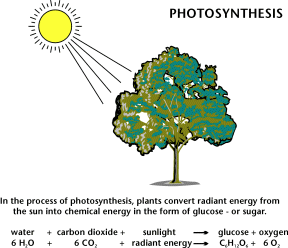
Define Photosynthesis. “The Putting Together With Light”
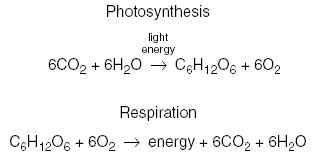
- Producers/autotrophs - organisms that can make their own food.
- We get so much from the process of photosynthesis: food, clothing medicines, wood, oxygen, paper, pencils, flowers, and so much more!
Respiration/Aerobic Respiration
- Why To produce ATP
- Whom? All aerobes (organisms that use oxygen); producers and consumers
1. Plants
2. Animals
3. Some bacteria
4. Protists
5. Some fungi
- Where? Mitochondria
- When? Constantly
- What? Food/glucose is being broken down to release energy
Define respiration. The metabolic processes whereby certain organisms obtain energy from organic molecules; processes that take place in the cells and tissues during which ATP energy is released and carbon dioxide and water is produced.
Fermentation/Anaerobic Respiration
- Why? To produce ATP
- Whom? All anaerobes (organisms that do not use oxygen)
1. Yeast/fungi
2. Some bacteria
- Where? Cytoplasm
- When? Constantly
- What? Food/glucose [is being fermented]
Define fermentation. Fermentation is a process by which food is broken down
without oxygen, in living organisms, to produce ATP.
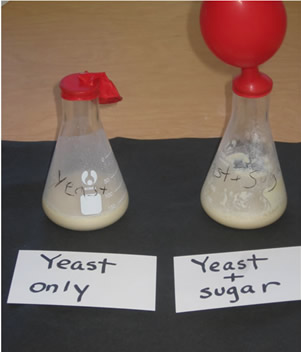
- What industries use fermentation?
1. Baking (CO2)
2. Brewing (Alcohol and CO2)
3. Dairy (Lactic Acid)
- What are the reactants ? One sugar (C6H12O6) (and a ATP investment).
- What are the products of fermentation? ATP and [CO2, alcohol] OR [ lactic acid]
Consumers/heterotrophs - organisms that must obtain food sources from other organisms.
- Herbivores - eat only plants
- Carnivores - eat only meat
- Omnivores - eat both plants and meat
- Scavengers - organisms that eat dead organisms
- Decomposers/Detritivores - Break down organisms, “nature’s recyclers”
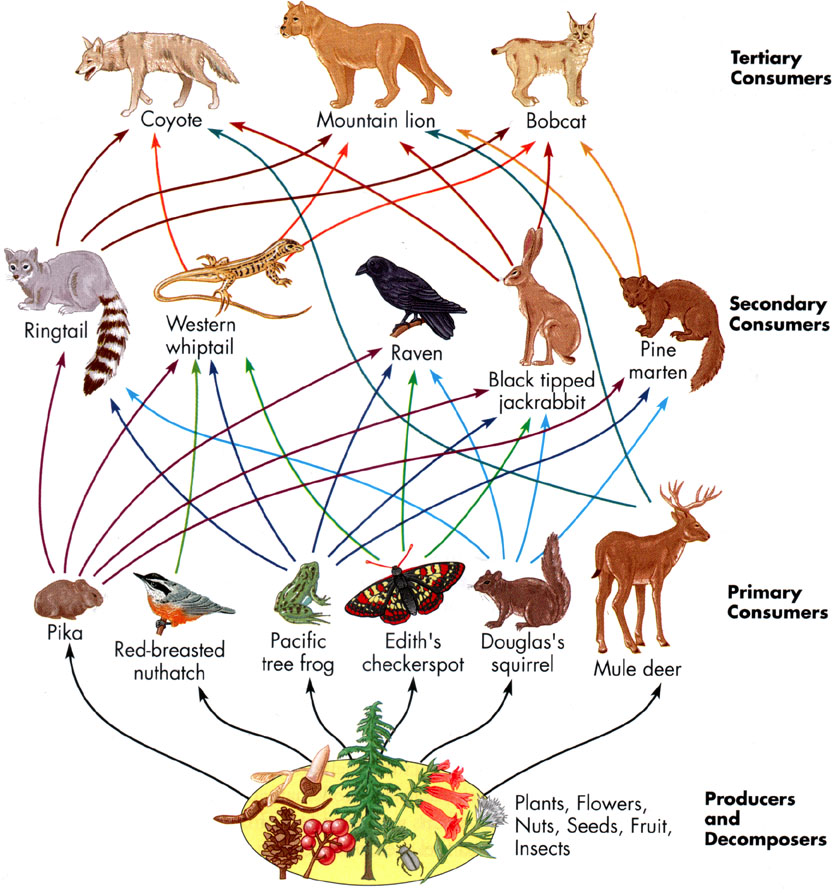
- Arrows point towards the organism obtaining energy or eating!
Metabolism - The chemical processes that occur within a living organism in order to maintain life.
Enzymes - Help speed up chemical processes by breaking substances apart or putting substances together.
- Use my blog, review worksheets and other assignments
- Use the textbook, pgs. 83-87
Monday, January 13, 2014
1/13-1/17
Monday
| -Math Mid-year Exam -Movement activity: Create a food web and discuss the interactions and flow of energy -Test on Photosynthesis and Respiration, Friday 1/17 |
Tuesday
| -Using the Theme of Energy: Trophic level energy transfer -Calorimeter demonstration |
Wednesday
| -Titration Lab: Respiration |
Thursday
| -Review for Test, Friday 1/17 |
Friday
| -Test on Photosynthesis and Respiration -Finish lab if necessary |
1/6-1/10
Monday
| -Review For Mid-year -How Do I Get Energy Internet Lesson is due |
Tuesday
| Review for Mid-year |
Wednesday
| -Language Arts Mid-year Exam -Review for Mid-year |
Thursday
| -Science Mid-year Exam -The Food Web Story |
Friday
| -Social Studies Mid-year Exam -Go over classwork -Eyewitness Plants video and notes |
Wednesday, January 1, 2014
Tuesday, December 17, 2013
Where Do I Get Energy?
Name________________________________ Date_____________________________
Where Do I Get Energy?
Internet Webquest Activity
Directions: Navigate the websites and collect information for each section of this webquest activity. Please make sure you write your responses in complete sentences and apply care and color in your drawings/sketches.
A. Photosynthesis Animation
1. What do plants take in through the roots? _____________________________________
2. What moves up stems to the leaves? ____________________________________________
3. Where does the leaf get water? _________________________________________________
4. Where does the leaf get carbon dioxide? _______________________________________
5. What does the leaf combine to make sugar? ____________________________________
6. What does the plant release into the air as a waste? ____________________________
7. What does the plant do with the sugar it makes? ________________________________
8. Why are plants important to the environment? __________________________________
B. Introduction to Photosynthesis - Illuminating Photosynthesis
- Click on “Launch Interactive”. Here, you will explore how photosynthesis works by helping the process along in this game.
The Cycle
1. What cycles do you see?
Atomic Shuffle
2. Draw a water molecule.
3. Draw a carbon dioxide molecule.
4. When carbon dioxide enters the cell, describe what happens.
5. Draw the structural molecule of glucose. How many carbon atoms, oxygen atoms, and hydrogen atoms?
6. Write the overall equation for photosynthesis.
Three Puzzlers
Puzzler 1: How many people can an average tree keep alive with the oxygen it puts out?
Puzzler 2: Can a plant stay alive without light? Explain.
Puzzler 3: Could a plant still grow if it had no oxygen?
C. The Busy Leaf
7. Where in a plant does photosynthesis happen?
8. Specifically in which organelle does photosynthesis happen? ____________________
- Draw a Chloroplast!!
Now Click on “INTRO TO PHOTOSYNTHESIS” at the top left of the page.
9. What are the two very important things that we get out of photosynthesis? Now think…why are those SO important?
10.How does the Earth get all of its energy? ___________________________________
11.What is the difference between an autotroph and a heterotroph? If you can’t figure it out, click on the word autotroph!
Now click on “ENERGY FLOW IN ORGANISMS” at the left of the page.
12 a. What types of organisms are Primary Producers?
b. What are Herbivores/Primary Consumers? Give 3 examples.
c. What are Carnivores/Secondary Consumers? Give 3 examples.
d. What are Decomposers? Give 3 examples.
e. What are Omnivores? Give 3 examples.
D. Why Leaves Change Color
13. Why do leaves change color (what factors)?
14. What does this say about their ability to carry out photosynthesis?
E. Endosymbiont Theory: Evolution of Organelles
15. What structures do mitochondria and chloroplasts have that are more similar with prokaryotes than with eukaryotes?
16. Which organelle, mitochondrion or chloroplast, is probably the descendent of Cyanobacteria (a photosynthetic bacterium)?
17. According to biologist Lynn Margulist, which organelle ancestor was the first to be ingested?
F. Cellular Respiration
- Read the article and click on the blue highlighted words to reveal diagrams needed for answering the following questions.
18. What is the precise definition of cellular respiration?
19. Draw the cyclical nature of the energy transformation between photosynthesis and respiration.
20. Where does the process of respiration begin? Where does this process get completed?
21. What are the products of respiration?
22. Draw the three-dimensional view of the mitochondrion.
23. What is aerobic respiration?
24. What is anaerobic respiration?
25. What is fermentation? Describe how the process is different in plants and animals.
G. Biology in Motion
- Watch the animation and read the information provided. Answer the following questions.
26. What is ATP?
27. How are the foods that we eat and ATP related?
28. THINK: ATP provides the body with energy. Give 3 examples of how ATP is used in organisms.
H. Enzymes - Watch these short videos on enzymes
29. Explain what enzymes do.
I. Metabolism - Watch this short video on digestion and metabolism
30. Do a search to explain the term metabolism.
Subscribe to:
Posts (Atom)